
A Book Recommendation?
Or, at the least, a book rumination

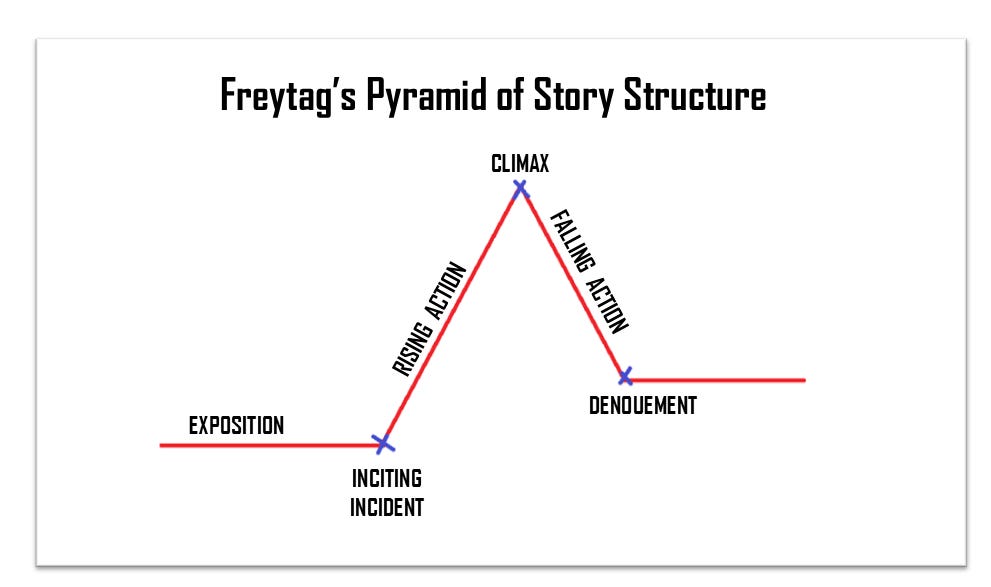
This month, I’ve been teaching my middle school students about story structure. While I wouldn’t dare go all jargon-y on them and utter the words “Freytag’s Pyramid,” I am demonstrating to them how almost any story they read has an exposition, rising action, climax, falling action, and resolution. My goal is for the short, short stories they write to be coherent, which is more likely to happen if they attempt to follow the model.
Yet, so many of my favorite books steer far clear of Freytag’s Pyramid; I suspect that after a lifetime of reading stories and novels which stay on the straight and narrow (and totally predictable) path, I crave something really quite different. Most of my favorite novels (Ulysses; Infinite Jest; Ducks, Newburyport) pack so much incident over their often excessive length that while you can pick out a plot (or dozens of plots), there’s just too much of life between their covers to allow the reader to map out anything like the Pyramid.
If you know anything about the three books I’ve listed in the previous paragraph, you know their daunting reputations. If nothing else, they are long, long, long. The prose style of each is resistant to easy reading. I’d argue the easiest to get through is the least familiar of those three titles, but every time I tell someone I think they’d really enjoy Ducks, Newburyport, I feel compelled to add that the book is more or less a 1,000 page sentence. Guess how many people take up my suggestion and try to read it? (Yet you should, you should).
It’s with a sense of cautious optimism that I recommend to you a book I’ve just finished; it has many of the merits of the non-plot driven books I love, but at a manageable 300 pages, and with a prose style that is both lovely and accessible.
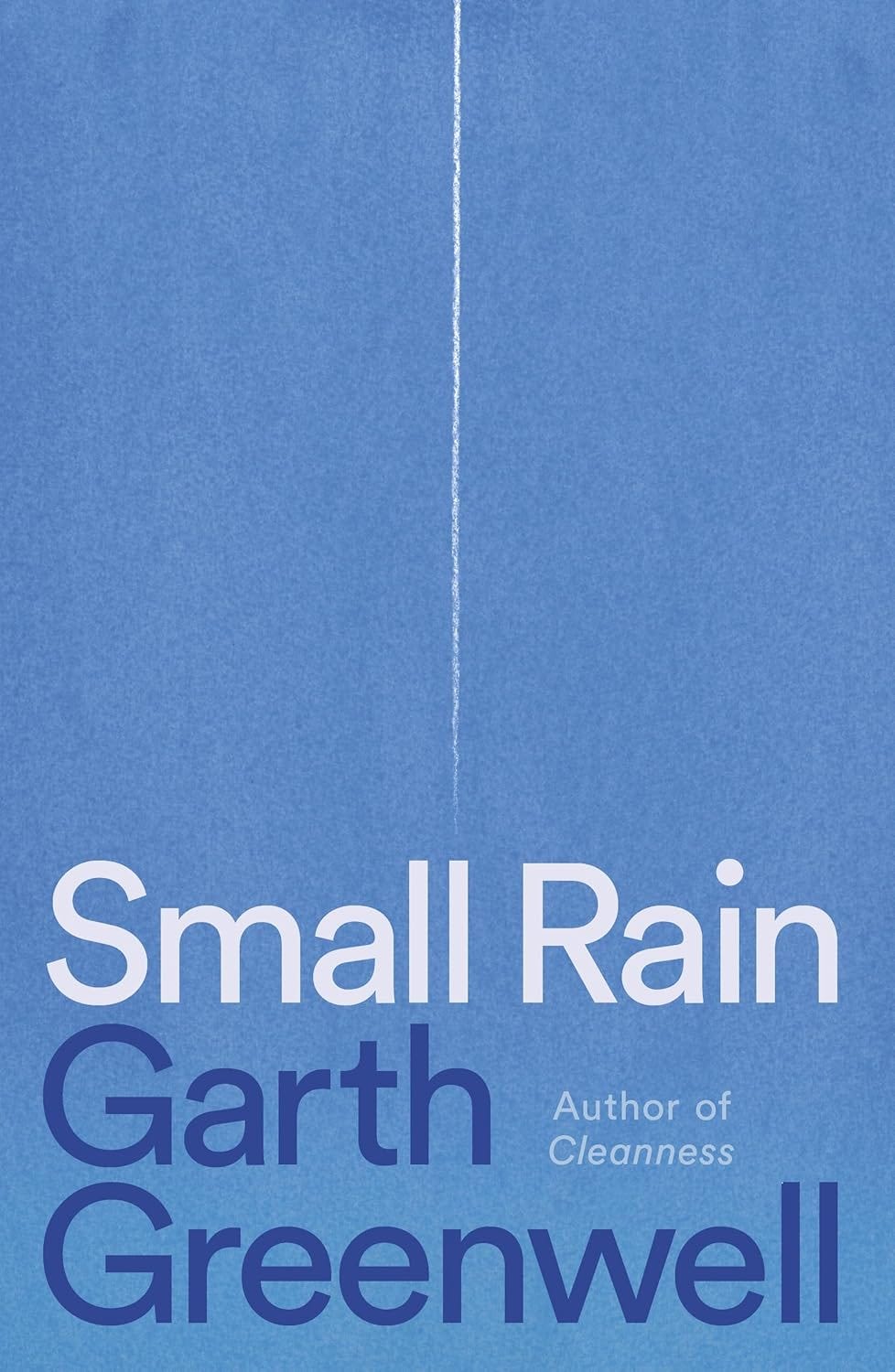
I would never have picked up Garth Greenwell’s Small Rain without what I call the Substack Networking Effect. I follow someone on Substack, who follows someone else, who follows Greenwell, so I’ve read a handful of his posts , enough to know that his tastes and mine (especially for opera and poetry, but really for a wide range of the arts) are aligned. Thus, when I saw Small Rain at a Little Free Library, I figured that maybe it would be worth a read. And indeed it was.
Here’s the “plot” in a nutshell: The first-person narrator, a fortyish poet and teacher in the American Midwest suffers a medical emergency and spends almost two weeks in the hospital before returning home. That’s it. Really. But like Ulysses, where Leopold Bloom’s actual day is relatively mundane but his mental day ranges far in time and space, Small Rain’s narrator has plenty of time while in hospital both to closely observe what is happening to him there and to allow his mind to revisit many moments from his past, most related to the tenuousness of mortality, from the COVID-19 pandemic, to problems with home construction contractors, to surviving a resent severe storm.
The hospital scenes call to mind HBO’s The Pitt, because the TV show is another work of art that doesn’t strike traditional story notes, but instead throws the viewer into the hurly-burly of the ER. Greenwell’s book is from the patient point of view rather than the doctors, and instead of the manic pace of an emergency room, we get the relatively eventless days and nights you’re likely familiar with if you’ve ever spent any serious time in the hospital. When very little happens during those long hospital days the life-enhancing moments that do arise (first taste of coffee again after too many days without, first potato chip after even longer, and eventually, first breath of fresh air, and first truly intimate contact with a lover) take on a magical aspect.
Now that I maybe have you hooked, I’ll risk losing you. Small Rain’s narrator is capable of riffing for pages at a time on almost anything. In fact, the title “small rain” is from a Mass by the late-medieval English composer John Taverner, which merits a six page reflection; almost three times as many pages are devoted to a close reading of a 34-word poem by George Oppen, which, trust me, will make you appreciate what poetry can do. I’m reminded of another long, long book that I love, which basically puts a full life on the page, Karl Ove Knausgard’s My Struggle (six volumes, 3,600 pages, with a notorious 438(!) page digression in the final volume on poet Paul Celan and Adolf Hitler). Greenwell does much of what Knausgard does, including I suspect using much of his real life. Also similar to Knausgard, Greenwell’s other two novels present the same first-person narrator at other moments of his life. But, unlike Knausgard, you can read Small Rain over days, not months.
Here’s Greenwell, discussing his book on the Barnes and Nobles’s podcast. Listen now, if you want more background before you read, or bookmark this page and check out the podcast after you read (which you should) Small Rain.
Post-Script
I always have at least two books going, and along with Greenwell. I’ve been reading Ellmann’s Joyce: The Biography of a Masterpiece and its Maker, about Richard Ellmann and his classic biography of James Joyce. Half the book recounts Ellmann’s life and half of it is the story of James Joyce. And, wouldn’t you know it, Richard Ellmann’s daughter is Lucy Ellmann, author of Ducks, Newburyport.