
After Apple-Picking
A seasonal close reading

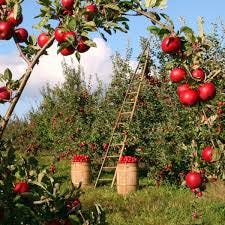
I’m attending a presentation this weekend of the poetry of Robert Frost, which included along with the invitation some homework, namely to read and be willing to discuss six Frost poems. I’m also just beginning to read Poems * Poets * Poetry: An Introduction and Anthology by Helen Vendler, which in its inside front cover features a quite famous checklist for exploring poems. What better way to try out Vendler’s method and prepare myself for Frost than by taking one of the six poems and giving Vendler’s tool a go.
First, the poem, “After Apple-Picking” from 1915:
My long two-pointed ladder’s sticking through a tree
Toward heaven still,
And there’s a barrel that I didn’t fill
Beside it, and there may be two or three
Apples I didn’t pick upon some bough.
But I am done with apple-picking now.
Essence of winter sleep is on the night,
The scent of apples: I am drowsing off.
I cannot rub the strangeness from my sight
I got from looking through a pane of glass
I skimmed this morning from the drinking trough
And held against the world of hoary grass.
It melted, and I let it fall and break.
But I was well
Upon my way to sleep before it fell,
And I could tell
What form my dreaming was about to take.
Magnified apples appear and disappear,
Stem end and blossom end,
And every fleck of russet showing clear.
My instep arch not only keeps the ache,
It keeps the pressure of a ladder-round.
I feel the ladder sway as the boughs bend.
And I keep hearing from the cellar bin
The rumbling sound
Of load on load of apples coming in.
For I have had too much
Of apple-picking: I am overtired
Of the great harvest I myself desired.
There were ten thousand thousand fruit to touch,
Cherish in hand, lift down, and not let fall.
For all
That struck the earth,
No matter if not bruised or spiked with stubble,
Went surely to the cider-apple heap
As of no worth.
One can see what will trouble
This sleep of mine, whatever sleep it is.
Were he not gone,
The woodchuck could say whether it’s like his
Long sleep, as I describe its coming on,
Or just some human sleep.
And now to the checklist:
Meaning: Can you paraphrase in prose the general outline of the poem?
The narrator has finished the chore of apple picking, not only for the day, but presumably for the season as well. He has left the ladder still against the tree and an unfilled barrel alongside. He thinks back to a thin piece of ice he took from the drinking trough and seems to suggest that his upcoming dream may derive from what he saw looking through the ice. Dream and reality converge as he pictures far too many apples, all requiring care least they fall to the ground to be then relegated to the cider-apple heap. He ends by wondering if a woodchuck he saw had a similar dream or not.
Antecedent scenario: What has been happening before the poem begins? What has provoked the speaker into utterance? How has a previous equilibrium been unsettled? What is the speaker upset about? Prior to the poem, the narrator has clearly done quite a lot of apple picking, not just that day but over the course of the harvesting season. He’s tired and ready to exaggerate about the “ten thousand thousand fruit” he has had to deal with, and the pressure he puts on himself to not let them fall. He expects his dreams to be haunted by apples as far as the eye can see, in a way that often happens when someone spends immense amounts of time on the same repetitive task.
Division into parts: How many? Where do the breaks come? The poem is in one 42-line stanza, with no breaks, although the presence of some short lines amidst the preponderance of lines in iambic pentameter create natural moments where the momentum of the poem slows down.
Climax: How do the other parts fall into place around it? The whole middle section of the poem is filled with stressful moments: magnified apples, an achy instep arch, a swaying ladder, rumbling sound of load on load of apples. Before it, there’s a sense of normalcy about the apple picking process, after it, comes the more loving idea that the apples are to be cherished and expertly handled, no matter how many there are. We end with the word “sleep” four times in five lines as the narrator thinks about whether his sleep resembles the woodchuck’s or not.
Other parts: What makes you divide the poem into these parts? Are there changes in person? In agency? In tense? In parts of speech? We spend the poem with one first-person narrator, beginning in the present tense with the end of apple picking, and then briefly slipping into the past as he views the world through “a pane of glass.” The dream in the middle section is in present tense, so that we can experience it as the dreamer did. This dream causes him to return to a reality (and the past tense) that is changed for him, as he looks back at his apple picking as overtiring, due to the stress of not wanting to drop any apples. We end with more hypothetical verbs (“could” and “would”) as the narrator thinks about the woodchuck.
Skeleton: What is the emotional curve on which the whole poem is strung? (It even helps to draw a shape – a crescendo, perhaps, or an hourglass-shape, or a sharp ascent following by a steep decline – so you’ll know how the poem looks to you as a whole.) Answering this question about the skeleton feels like an opportunity to summarize what I’ve said so far. My visual image here is of a line graph that begins at a relatively low height for the end of the apple picking session, jumps to a much higher level for the dream, and then sinks back pretty quickly to a low plateau, with the overly tired narrator, and then lower still for the conclusion with its five “sleeps.”
Games with a skeleton: How is this emotional curve made new? So much of the poem after its naturalistic beginning is dreamlike. It’s almost like the narrator after considering the dream he thinks he will have, then looks back at his actual apple picking as if it were a dream, not a reality. There’s enough ambiguity about what exactly happened vs. what is perceived as a dream to give the poem a distinctive tone. Also, when you’re in a dream state, it opens the poem to the idea that the apple picking is symbolic of something different. One pictures a god-like figure tending to the souls of his followers and becoming overly exhausted with the responsibility.
Language: What are the contexts of diction; chains of significant relation; parts of speech emphasized; tenses; and so on? The short lines seem to mark important moments, or ideas, or turning points. “Toward heaven still” hints at a god figure. “But I was well” describes someone who is not necessarily so well. “As of no worth” feels like such an abruptly harsh judgement on those who fall. While every line rhymes with at least one other line, the overall pattern seems all over the place, which keeps the poem from ever feeling stable. It’s worth noting that the only place where three lines in succession rhyme (“well” “fell” “tell”) is where the dream state begins. Meanwhile, one of the longest gaps between rhyming words (“heap” “sleep”) comes at the end as our troubled narrator finally attains some “human sleep.”
Tone: Can you name the pieces of the emotional curve – the changes in tone you can hear in the speaker’s voice as the poem goes along? One interesting tonal shift is from this early comment: “I am done with apple picking now” to this: “for I have had too much of apple-picking.” Never does the tone become truly nightmarish, but for this relatively reticent narrator, we can hear his move from temporarily done to totally ready to stop.
Agency and its speech acts: Who is the main agent in the poem, and does the main agent change as the poem progresses? See what the main speech act of the agent is, and whether that changes. Notice oddities about the agent and speech acts. Shifts in this narrator’s tone tend to be subtle, but evident nevertheless. The narrator who begins this poem doesn't seem like someone who would later exaggerate the reality he faces with its ten thousand thousand apples (Doesn’t that translate to 10,000,000 apples? Surely that’s too many?).
Roads not taken: Can you imagine the poem written in a different person, or a different tense, or with the parts rearranged, or with an additional stanza, or with on stanza left out, conjecturing why the poet might have wanted these pieces in this order? It’s interesting to think about how a section from the perspective of an apple or two might change the poem, whether that apple was tenderly and successfully transferred to the barrel, or whether that apple was dropped and relegated to the cider-apple heap. But, I suppose the god-like apple picker, confronted with 10,000,000 apples, cannot really take their perspective.
Genres: What are they by content, by speech act, by outer form? Here’s another space to summarize, it seems. “After Apple-Picking” is both a narrative poem about someone who works his apple orchard and an allegory about any figure who becomes burdened by too much responsibility. The rhyme scheme and iambic pentameter lines assert control, while the shorter, irregular lines disrupt that control.
Imagination: What has it invented that is new, striking, memorable – in content, in genre, in analogies, in rhythm, in a speaker? I’ve gone apple picking only once that I can recall, and enjoyed the hour I spent. Frost’s poem makes me aware of how my feeling would change if that were my job, rather than an hour’s lark. Magnified apples, load on load of apples, ten thousand thousand fruit, it’s all enough to tire me out. Yet with the prospect of dreaming about that job as well, there may be no rest in sight.
I hope you’ll try Vendler’s checklist out for yourself with any poem. I certainly feel more ready to share my thoughts at the Frost presentation this weekend.