
If Memory Serves
Memorable encounters

Two recent events in the arts world found me revisiting indelible theatrical memories from the 1980’s, their interconnections, and some personal encounters that I’ll never forget.
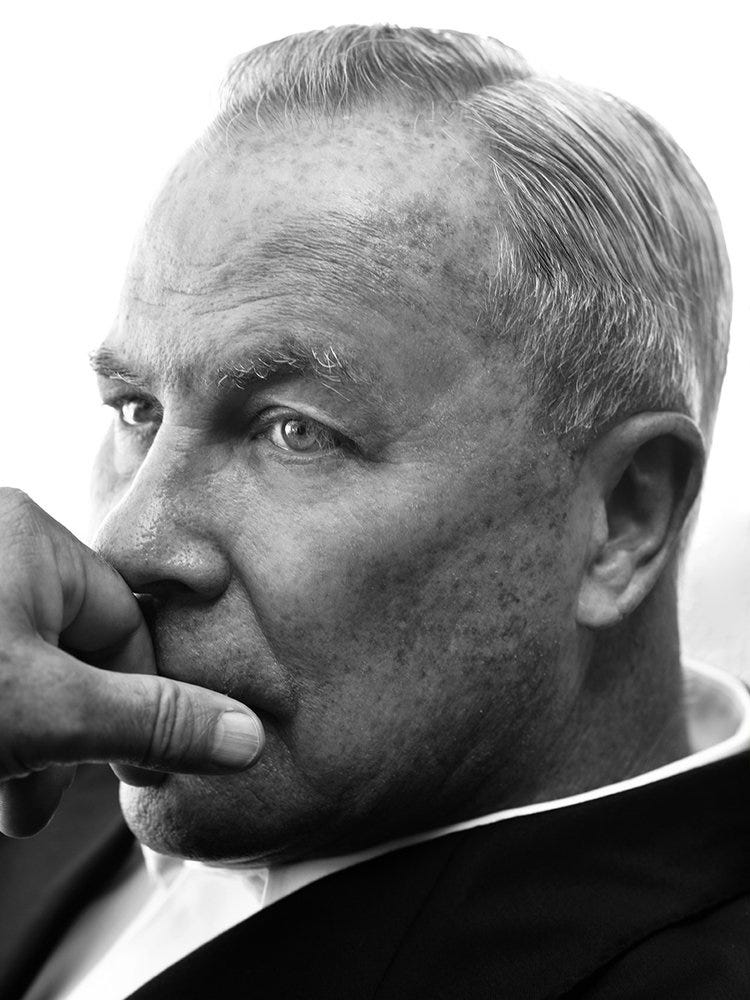
This past month saw the passing of one of the most visionary theater directors of all time, Robert Wilson. His highly experimental aesthetic was in line with what one might see in Europe, yet Wilson was a son of Waco, Texas, and maintained a personal style very much that of the American West. Wilson first gained fame by directing the original New York performances in the 70’s of Einstein on the Beach, with music by Philip Glass. Glass’s music played a part in the one Wilson production I ever saw in person, the American Repertory Theater’s 1985 production of the CIVIL warS: a Tree is Best Measured When it is Down. Wilson planned this work to be 12-hours long, to be staged in conjunction with the 1984 Summer Olympics in Los Angeles amazingly enough, given its highly avant-garde nature. To the best of my memory, the ART version ran between 3-4 hours, with one scene typical of Wilson etched indelibly in my memory: a highly stylized vehicle made its way from one side of the stage to the other, to the repeated recording of a 1905 song, “In My Merry Oldsmobile,” in a process which took what felt like close to half an hour. I knew enough going in to not expect any sort of narrative, and once I got on board with the highly ritualized glacial motion combined with vivid stage pictures and generally repetitive music (thus, Philip Glass), I was entranced. I went a second time during the run, knowing I would not likely see its like again ever.
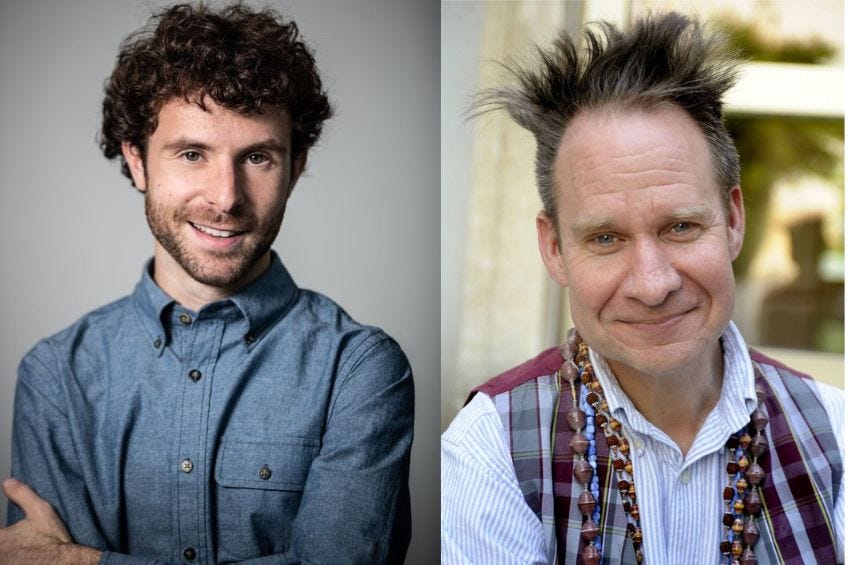
The 1980’s were a richly experimental time for the American Repertory, and I was there for all of it, including another director whose ability to match movement and music was (and is) unsurpassed, Peter Sellars. The second recent event I referred to at the beginning was a staged performance of Music For New Bodies at Tanglewood, with music by Matthew Aucoin (pictured above (left) with Sellars) setting the poetry of Jorie Graham, Aucoin’s teacher at Harvard, Sellars’s alma mater. While I only saw one Wilson production, I was fortunate in that so much of Sellars’s early work was in Boston. I attended all of the following: a three-hour version of Wagner’s Ring with marionettes that he directed while a student, a chamber opera by Peter Maxwell Davies called The Lighthouse, starring Sanford Sylvan, who just a few years before was my classical music clerk at the downtown Boston Barnes & Noble, a top-10-ever (for me) staged performance of Handel’s oratorio Saul at Harvard’s Sanders Theater, (not just a favorite of mine but also of the Boston Globe’s music critic at the time, Richard Dyer), a 1990 Marriage of Figaro, with scenes in, among other contemporary settings, Trump Tower in New York, and finally, an American Repertory staging of Handel’s Orlando, which received so many performances (I went twice) that it is likely the opera staged more times in the Boston area than any other.
During this same decade, I was a member (eventually president) of the New England Opera Club, a group of opera lovers who met monthly in a hotel function room in Brookline, where we generally played recordings of favorite singers for each other. Occasionally we’d have a special guest; somehow, even though his vision ran counter to the generally conservative tastes of our members, we landed Sellars as a guest. He was so boyishly enthusiastic that he won over most of the old guard; I’m pleased to report that even in his late 60’s he’s maintained that boyish enthusiasm. I’ll be there for Music For New Bodies when it eventually makes its way to Boston; it feels like a passing of the torch from Sellars to composer Aucoin (son of Boston Globe theater critic Don Aucoin) as Boston-area opera phenom.
Continuing and ending with other connections:
In a Peter Sellars mood, I rented a DVD of his performance at the Glyndebourne Festival in 1996 of Handel’s Theodora. It featured one of my favorite singers, soprano Dawn Upshaw, whom I was lucky enough to meet in person after her performance at Tanglewood of songs by another Boston area composer, Osvaldo Golijov. I asked her how fortunate she felt to be able to sing this beautiful piece:
I first became aware of Golijov thanks to another rave review in the Globe by Richard Dyer of his Pasion Segun San Marcos as performed by the BSO. Here’s an early production of the same work from Stuttgart:
Finally, Richard Dyer himself was a guest at the New England Opera Club way back when. Once again, most of the members weren’t fans, given that they all could remember one negative review or another by Dyer of one of their favorite singers. Dyer came with an armful of albums of his favorites; like Sellars, his obvious love of opera won the day. He “retired” from the Globe in 2006 (my memory is that the paper bought out some of their higher-paid writers), and I always found myself wondering at musical performances after that, “What would Richard Dyer think?” Alas, he passed away last year but it’s always pleasant to think back to the days when Dyer would be in the paper multiple times a week reviewing music around Boston. I wish the Globe’s on-line archive went back that far. I’d love to read that Saul review again.