
It's a Puzzlement
or, Words, Words, Words

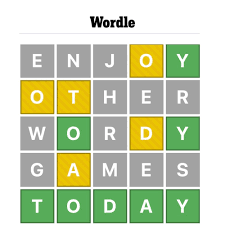
Any activity that takes up almost 10% of my waking hours certainly merits a Poetic Musing, don’t you think? Especially if said activity occupies a similar percent of your time and especially if I can call your attention to new ways to engagingly fill that time.
Here is my personal Top 10 List of smartphone word games, along with mini-descriptions and a couple of strategies I employ:
#10: Keyword
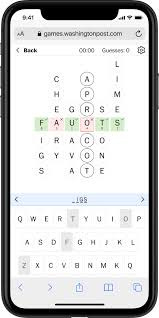
For fun, I decided to start this list by looking for a game I don’t currently play, but that looks potentially addictive, and hit upon Keyword from the Washington Post. You are presented with six words, each missing a letter. Pick the right missing letters and you will form a new 6-letter word. If this seems too easy to you, there is a timer included with the game so that you can play for both speed and accuracy. If memory serves, this game, or one very similar, was once in my rotation. I’m happy to welcome it back.
#9: Frase By Forbes
I’m not a big fan of anagrams, and suspected that a word game offering up sometimes as many as 30 letters to anagram would be impossible, but Frase By Forbes, by asking you to anagram the letters to form a familiar phrase and by giving you the number of letters in each word of the phrase, makes the challenge much easier than, say, seeing six letters and trying to come up with an anagram for them. I’ve temporarily taken this game out of my rotation; after all there are only so many hours in a day. But it will likely return.
#8: Fluxis

This game, from the Atlantic, is brand new, and for me, the jury is out as to whether it will become a regular, but if you want to get in on the early days of a new game, give Fluxis a try. The basic idea is to create a chain of words with the last letters of one word starting the next word. The more letters you are able to include in the overlap, the higher your score. The game provides restrictions on the words you can use. You can keep trying over and over to increase your score if you’re not feeling good about where your chain is headed. This to me may be a bug rather than a feature, since it means you can spend way, way too much time on this game.
#7: Stackdown
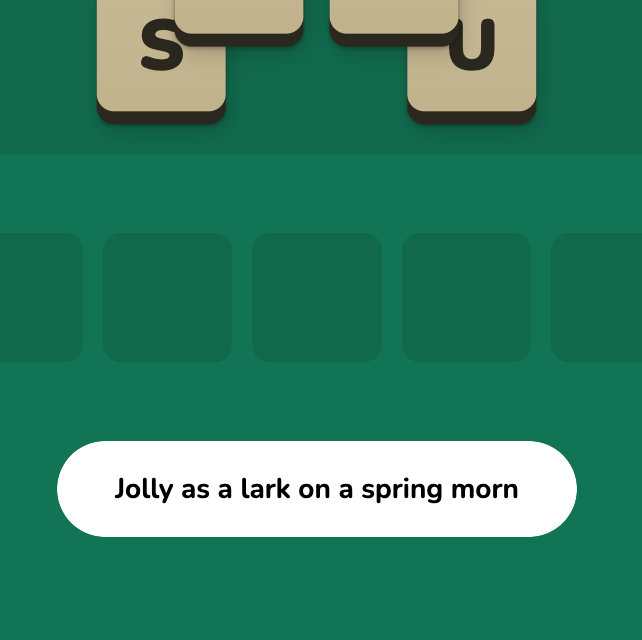
Speaking of brand new games, the puzzle people that bring you Waffle (see below) have just this week brought us Stackdown. You are presented with a set of overlapping letter tiles, from which you need to come up with a series of six-letter words. The trick is that as you use a tile, it then frees up tiles underneath it which you can use on the same word or a later word. Any time you are stuck, you can ask for a hint, which for better or for worse generally gives away the answer. Your score depends on both time and on the number of hints used.
#6: Strands
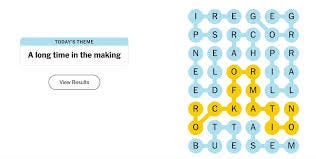
Strands, from the New York Times, calls for not just word game skills, but real world knowledge as well, a combination which also describes my #1 game (see below). From the theme, you need to find a word or phrase which spans from one side of the grid to the opposite side, as well as a series of smaller words which the Spangram describes. Strands includes hints, which I try to avoid, since I can usually find a word somewhere in the grid to get me started. My suggestion is to look for less common letters and try to find a work using them.
#5: Bracket City
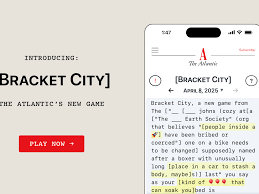
If you’ve not tried it yet, there’s nothing quite like the Atlantic’s Bracket City Here again, real world knowledge is helpful, as you need to answer a trivia-type question, the answer to which is then part of an outer-bracket question, the answer to which is then part of another outer-bracket question, the answer to which… What makes this game fun is that you can use what you think the outer bracket question might be to solve the inner-bracket question. Probably none of this makes much sense if you’ve never played Bracket City, but you’ll catch on quickly. You can ask for hints, including the first letter of a word. You also can make wrong guesses but still keep playing and even ask to be given the whole answer for as many words as you like, but hints, wrong guesses, and giveaways can lower your score to zero pretty fast.
#4: Waffle
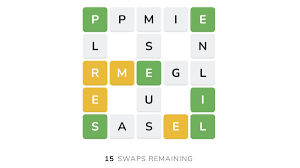
This may be the game where I’m most proud of my personal record. Waffle asks you to form six 5-letter words by swapping tiles. While you are allowed 15 swaps to “win,” each puzzle can be solved in 10 swaps, which I set as my daily goal. To get there, I try to figure out all six words before swapping any tiles and then plan to make as many swaps that place two letters successfully as I can. I’ve accomplished that feat 88% of the time, and challenge you to beat that.
#3: Wordle
Why do I suspect that none of you need me to supply a picture, a hyperlink, or a description here? I will offer you a strategy though. Start with five-letter words featuring two common consonants, two less common consonants, and a vowel in the center (such as BRING or STAMP). Keep trying to come up with words like this for as long as you can. By about your fourth guess, there are often so few consonants left to pick that the word of the day becomes evident.
#2: Squaredle
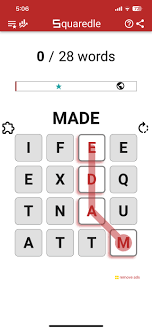
I remember the first time I ever tried Squaredle, which most days features a 4 x 4 grid where you need to form words of four or more letters by moving from one letter to another vertically, horizontally, or diagonally. The grid that first day included over 70 words and I thought, “There’s no way.” But a little bit of patience and a hint or two later, I’d found them all, and such is the case every time I’ve ever played. The puzzles get progressively harder during the week, with the exception of Saturdays, where the grid is often differently shaped. Squaredle also allows you to try some special puzzles, often tied to holidays, with much larger grids and upwards of 600 words to find, if you really want to fritter away your one precious life.
#1: Connections
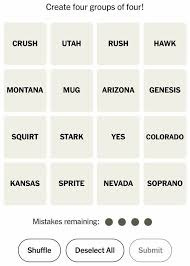
Here truly is a game that combines wordplay, trivia, and thinking differently. Find the Connections and create four groups of four that share something in common. I personally have to love a game that connects REICH, ENO, GLASS, and CAGE (contemporary composers) or BISHOP, LORDE, POPE, and BURNS (poets). The more you play and see the different types of connections, the greater your success rate will be. Here’s a tip: If you’ve never heard of one of the words, the connection usually involves wordplay, where you need only pay attention to the beginning or ending letters of the word in seeking connections.
This is where I sometimes will ask you to consider adding a comment at the end of this post, but I too rarely hear from you. Here’s my fervent request: If there’s a word game you play that I’ve not listed, please tell us the name in the Comments section.
Post-Script:
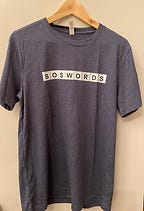
If you know me, you know I love crossword puzzles, and may be surprised to see there’s no crossword puzzle site in my smartphone Top 10 games. That’s because I’m primarily a pen-and-paper solver. I’ll occasionally solve on my laptop, but never on my smartphone, for reasons which for me are too obvious to note. Rather than a crossword site, my recommendation for you is an online, multiweek tournament, Boswords, so named because it originated in the Boston area as an in-person event, and then migrated online during Covid. In both the fall and the spring, Boswords hosts ten weeks of competitive solving. The puzzles feature three sets of clues, so you can find the level of clue complexity that works for you and compete against those similarly minded. Check out their site for all kinds of information about the upcoming fall tournament, including sample puzzles at all clue levels. You can solve on Mondays alongside a Twitch broadcast with features and guests from the puzzling world, or you can solve any time during the week; either way, your score is included in the weekly standings.