
Opera News
Not the magazine, which I still miss

Boston remains a city where there is far too little staged opera to see, so fans need to be thankful for small favors. One such favor is the Boston Symphony Orchestra’s commitment to performing opera in concert, generally twice a year, once at Tanglewood and once at Symphony Hall.
This season’s opera is upon us, as the BSO resumes its 2025-2026 season following a month of Holiday Pops with Samuel Barber’s Vanessa, on January 8 and 10. It’s an indication of how little opera there is to see in Boston that Vanessa is a co-production of the BSO and the Boston Lyric Opera; the BLO season is small enough as it is without its resources being committed to what is essentially a BSO concert.
Anyway, enough complaining. These two concerts are a rare opportunity to hear an opera that when it debuted at the Metropolitan Opera in 1958 succeeded well enough that the Met confidently commissioned Barber to open their new opera house in 1966. That opera, Anthony and Cleopatra failed miserably and set back the course of new American opera at the Met for a few decades.
Barber’s music, when new, struck most observers as much more traditional and lyric than the more atonal music then in vogue. The Barber piece you’re most likely to know is his Adagio for Strings, used memorably in the movie Platoon (and countless times before and since) to communicate a deep sense of mourning
Vanessa is more demanding on the ears, with fewer of the set pieces (arias, duets, ensembles) that mark the operas of composers like Mozart, Verdi, and Puccini. The BSO is featuring Barber’s opera as a part of its year-long celebration of American music, “E Pluribus Unum: From Many, One,” yet in some ways Vanessa is an odd choice. Its story is set in “a northern country,” presumably in Europe, complete with baronial mansion, New Years Eve Ball, and dashing young tenor arriving by sleigh in a fierce winter storm conjuring memories of Russia and Dr. Zhivago, rather than America. My preference for a mid-20th century American opera revival would be Douglas Moore’s The Ballad of Baby Doe, a star vehicle for Beverly Sills, set in Leadville, Colorado during the era of the gold mines:
If you want to sample vocal music by Barber that truly fits the category of Americana, here is his setting of Knoxville, Summer of 1915 with text by James Agee, in a recording by Dawn Upshaw:
While much of Vanessa comes across as dialogue set to music (or recitative, to use the term for the sections between the arias and ensembles of traditional opera), the opera does feature a lovely quintet in its closing section. Here’s a recording of the original cast of Eleanor Steber, Rosalind Elias, Regina Resnik, Nicola Gedda, and George Cehanovsky:
I plan to go the the BSO Thursday performance on January 8, opting for rush tickets (show up a little before 5pm and queue up for $15 tickets, $5 more than last year but still a great deal). If I’ve piqued your interest and you want more background, here’s an introduction:
Post-Script
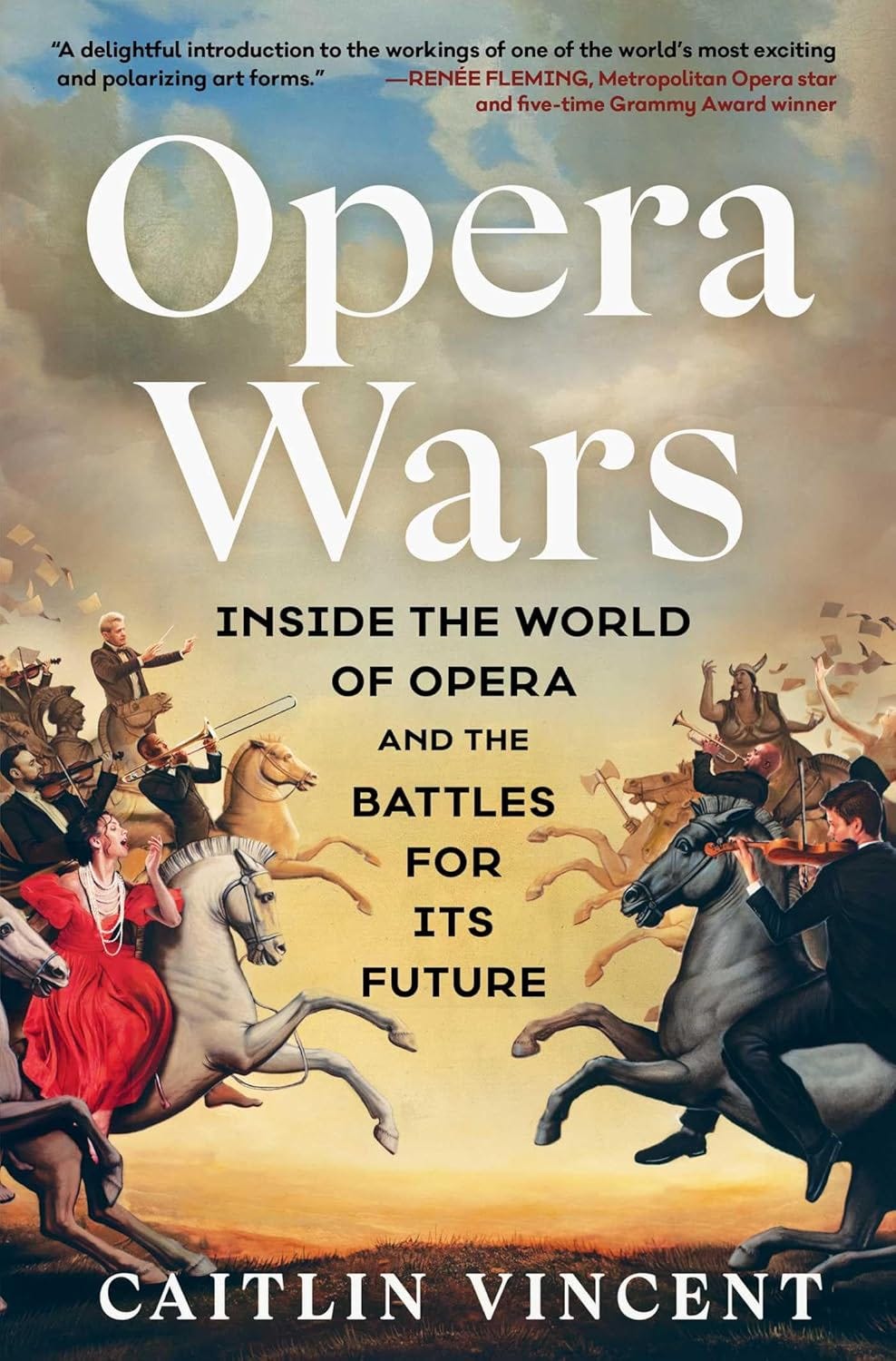
You might have noticed the book Opera Wars, which kicked off these Musings. It’s being published next month, and its author, Caitlin Vincent, will be speaking at the Harvard Book Store in Cambridge on January 6 at 7pm. Among the Wars the book considers is that between traditionalism and modernism in opera. For years at the Metropolitan Opera, traditional productions of operas from the late 1700s to the early 20th century ruled the roost, but recently the Met has spiced up its lineup with American and world premieres. Still largely missing from their repertory? Revivals of operas from the mid-20th century, such as Vanessa, not heard on the Met stage since 1965.
For a fun take on traditionalism vs. modernism when it comes to opera staging, try this video:
Finally, my comment in the subtitle of this post about Opera News magazine: When I first got into opera in the late 1970’s, my education in the art form came largely from the weekly live broadcasts of the Met in combination with Opera News, which during the broadcast season came out almost every week, with a battery of stories about that week’s opera. Eventually, Opera News became a monthly, and later was basically swallowed up by another magazine, Opera. It’s a far lesser thing, alas. At least the live Met broadcasts continue, through the end of May, on WHRB-FM.