
Some Random Thoughts...
on Poetic Form, Icelandic Poetry. and Poetry in Translation

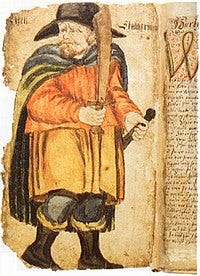
In reading about the intersection of Icelandic poetry and Icelandic sagas, I came upon this interesting quote from The Icelandic Saga, by Peter Hallberg:
[Icelandic] heroes…have been endowed with no mean measure of courage and ambition. But their deportment, nevertheless, shows in what direction the ideal of a proud and dignified bearing lay. It is an idea which strikes us as being singularly rigid and armor-plated. It has a certain affinity with the spirit and style of the ancient skaldic poetry, whose form made iron demands on the poet.
First, a definition: “skald” is Old Norse for poet, and carries behind it the entire tradition of the medieval oral poetry of Scandinavia, including the idea that poets had a role in society to praise their rulers in elaborate presentations in royal courts. When the tales of Icelandic heroes and Norse kings were set down in written form, the text would often include these poems of praise; in fact, in some cases the hero was both a Viking warrior and a poet.
Hallberg suggests a direct relationship between the highly specific attributes of honor in 1000 AD Iceland and the rigid form of Icelandic poetry with its “iron demands.” This may be true, but it isn’t unique to Iceland. All poetic forms make more or less “iron demands” on the poet, and most poetry before the last 150 years or so closely followed a prescribed form.
Ask most people to think about the subjects they explored in grade school. “Poetry” and “Mathematics”would likely strike them as two subjects with the most significant differences between them. Yet, consider the rules that define for example, one type of sonnet:
The poem should be exactly 14 lines
The end rhymes should follow the pattern a,b,b,a,a,b,b,a,c,d,c,d,c,d
Each line should consist of 10 syllables
The accent pattern of each line should be short, long, short, long, short, long, short, long, short, long
The first four line introduce a problem, conflict, or situation
The next four lines fleshes out the problem, conflict, or situation
The final six lines resolve the problem or conflict in some fashion or shed a final, more definitive light on the situation
With that definition, doesn’t it feel like we’re more in the area of mathematical logic than emotional and aesthetic utterance? How is it that such “iron demands” can result in memorable poetry?
The New Colossus
by Emma Lazarus
Not like the brazen giant of Greek fame,
With conquering limbs astride from land to land;
Here at our sea-washed, sunset gates shall stand
A mighty woman with a torch, whose flame
Is the imprisoned lightning, and her name
Mother of Exiles. From her beacon-hand
Glows world-wide welcome; her mild eyes command
The air-bridged harbor that twin cities frame.
“Keep, ancient lands, your storied pomp!” cries she
With silent lips. “Give me your tired, your poor,
Your huddled masses yearning to breathe free,
The wretched refuse of your teeming shore.
Send these, the homeless, tempest-tost to me,
I lift my lamp beside the golden door!”
Until I watched the PBS episode on “The New Colossus” episode of Poetry in America, I didn’t even realize the poem was a sonnet. The sonnet form both constrained Emma Lazarus and facilitated her finding memorable (and memorizable) turns of phrase. It’s worth noting that the most memorable (“Give me your tired, your poor, your huddled masses yearning to breathe free”) starts in the middle of a line, rather than at the beginning, and is sixteen syllables long, not ten. The sonnet structure is the framework for “The New Colossus,” but we sense it almost unconsciously.
Here’s the rules for a type of Icelandic skaldic poetry, drottkvaett, (“courtly meter”) that Peter Hallberg found, rightly, to present the poet with the aforementioned “iron demands”:
Each stanza is six lines
Each line has six syllables
Each line has three stressed syllables
The odd-numbered lines have two stressed syllables that begin with the same consonant sound
The even-numbered lines begin with the same consonant sound from the two stressed syllables in the preceding line
The rhythm of each line for the most part is trochaic (stressed, then unstressed syllable)
Two of the stressed syllables in the odd-numbered lines have consonant sounds that form a near rhyme
Two of the stressed syllables in the even-numbered lines rhyme
Most stanzas include kennings, a type of metaphor that replaces a single word noun with two or more words in figurative language
Got that? I figured I would try as best I could to compose a stanza in English, strictly following these nine rules, but I’m no poet, and I do want to publish this post sometime this year, so I found on YouTube this video, with Dr. Jackson Crawford, instructor of Nordic Studies at the University of Colorado, Boulder. He walks through drottkvaett, then takes a shot at writing an English language stanza:
I hope you watched the clip, since it shows by example the Old Norse poetic rules I listed above, but if you didn’t, I’ll share with you Dr. Crawford’s poem:
Spear-swallow, not sparing
spited foes in fighting,
is that pain of pine-trees
part of your own heart-clew?
Knife-wing, are you woe-fed,
war’s breath, cast to master
sky-candle’s clear landscape
king of all the winged?
That was a challenge to write, I’m sure, and like much Icelandic poetry, a challenge to understand. But a far greater challenge would be to translate a stanza of Icelandic poetry into English, retaining the meaning, and following all the rules. Suffice it to say, most translators don’t even try.
Can it be said that a translation into English of skaldic poetry that doesn’t follow the rules is really presenting us the poem? The poem, by definition, follows a rigorous set of rules, but the translation reads as modern free verse. So no, unless I can speak and understand Icelandic/Old Norse, I’ll never really grasp the poem. If you listen to Dr. Crawford read in the video first the original and then his translation, the two sound worlds are so different that it’s clear the translation cannot do justice to the original.
But I wouldn’t want to deny myself the pleasure of reading the free verse translation with which I’ll end. Egil’s Saga follows the escapades of the titular Viking warrior and poet. The violence he perpetrates on others, sometimes justified, sometimes not, makes for a rollicking good read. But as he ages, Egil mellows somewhat. He commemorates and more importantly mourns the death of two of his sons by composing the 25-stanza Sonatorrak. Here’s the first and last stanzas of Sonatorrek in English translation in The Sagas of Icelanders, translated by Bernard Scudder:
My tongue is sluggish
for me to move,
my poem’s scales
ponderous to raise.
The god’s prize
is beyond my grasp,
tough to drag out
from my mind’s haunts.
Now my course is tough:
Death, close sister
of Odin’s enemy,
stands on the ness:
with resolution
and without remorse
I will gladly
await my own.